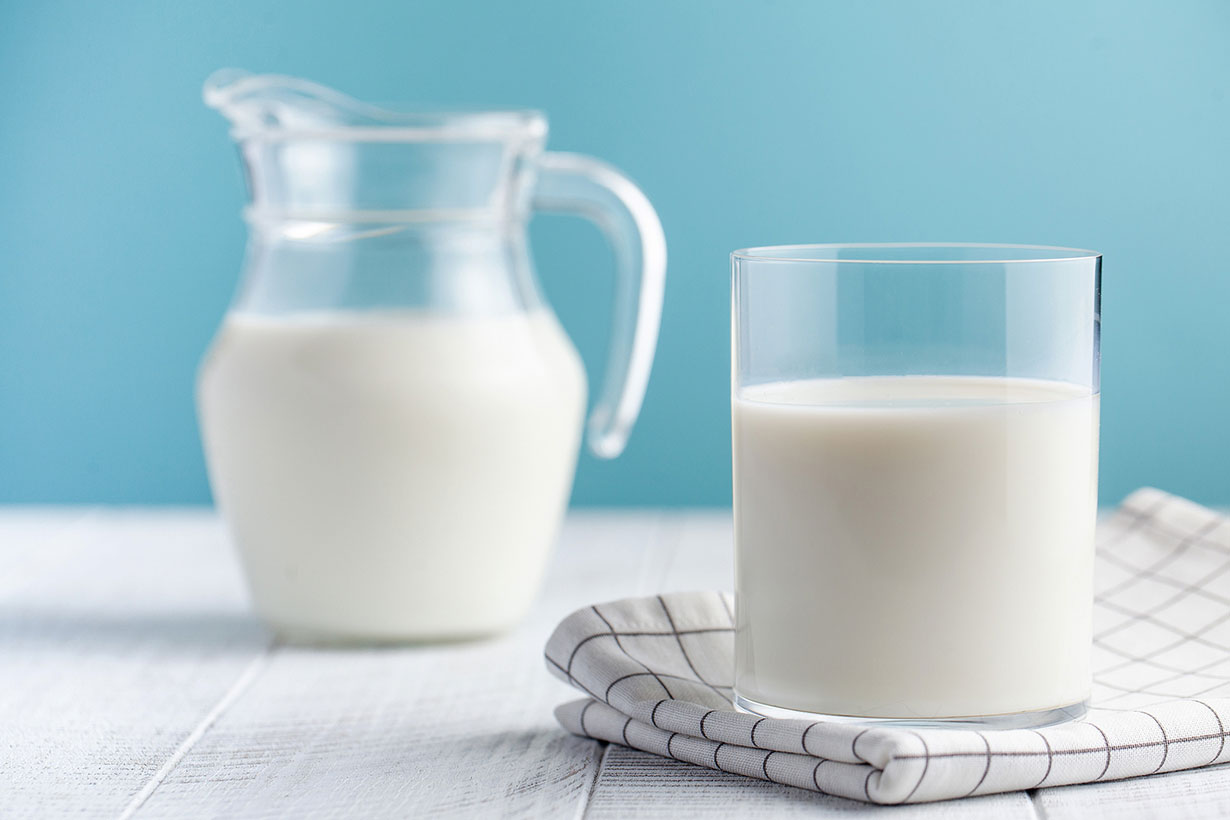
Skim milk is a popular dairy product with almost zero milk fat content.
It typically contains less than 0.1g fat per 100 ml and has fewer calories than whole milk, yet it provides slightly more protein and a similar vitamin and mineral profile.
Skim milk is a nutrient-dense food choice, providing notable amounts of protein, calcium, phosphorus, vitamin B12, and vitamin D. However, scientific studies show mixed findings on its potential health effects compared to whole milk.
This article examines the potential benefits, drawbacks, and nutritional profile of skim milk, and what current research shows about how it compares to whole milk.
Table of contents
What is Skim Milk?

As mentioned, skim milk typically has the majority of its milkfat content “skimmed” out, leaving the milk with <0.1g fat per 100 ml.
Depending on where you live, you may know it by a different name, with common names globally including:
- Skim milk
- Nonfat milk
- Skimmed milk
- Fat-free milk
As skim milk has fewer total calories than other milk varieties, it is sometimes associated with dieting. This reduced calorie content is due to the fat being removed.
Since whole milk contains around 3–4 grams of fat per 100 ml, this is equal to 27–36 calories (9 calories per gram of fat).
Some people may also choose skim milk specifically for its high protein content relative to total calories.
Key Nutrients in Skim Milk
A typical 245g cup of skim milk contains the following key nutrients:
- Calories: 83 kcal
- Carbohydrate: 12.2g*
- Sugars: 12.5g
- Fat: 0.20g fat
- Saturated fat: 0.14g
- Protein: 8.26g
- Vitamin B12: 51% of the Daily Value (% DV)
- Riboflavin (B2): 35% DV
- Calcium: 23% DV
- Phosphorus: 20% DV
- Vitamin D: 15% DV
- Potassium: 8% DV
Source: USDA – Milk, nonfat, added vitamin A and D
Note: USDA Data Inconsistency
You may have noticed the asterisk in the nutrient values above. This is because the USDA data appears to contain an error, with the total carbohydrate amount listed as being 12.2g but the sugar content listed as 12.5g.
Since the amount of sugar in a food cannot be higher than the total amount of carbohydrate, the USDA data appears to be inconsistent here. We have listed the official USDA data, but it is likely that the carbohydrate content should also be listed as 12.5g.
Skim Milk vs. Whole Milk: Nutrition Comparison
You may be wondering how the nutrient profile of skim milk compares to whole milk, and we’ll look at that now.
While the two are comparable in terms of their vitamin and mineral content, there are significant differences in their calorie and macronutrient content.
The table below shows how the two compare for calories, carbohydrates, fat, and protein per 245 ml cup.
| Nutrient | Skim milk (245g cup) | Whole milk (244g cup) |
|---|---|---|
| Calories | 83.3 kcal | 149 kcal |
| Carbohydrates | 12.2g | 11.7g |
| Fat | 0.20g | 7.93g |
| Saturated fat | 0.14g | 4.54g |
| Protein | 8.26g | 7.69g |
Sources: USDA – Nonfat milk and USDA – Whole milk
As the table shows:
- Calories: Whole milk contains nearly double the calories of skim milk.
- Carbs and fat: Skim milk has slightly higher carbohydrate levels, and a significantly reduced fat and saturated fat content.
- Protein: Skim milk has slightly more protein.
Who May Want to Choose Skim Milk?
In short, you may want to choose skim milk if you want to get a comparable vitamin and mineral profile to whole milk while also:
- Keeping calories low.
- Reducing saturated fat intake.
- Getting slightly more protein, although this difference isn’t as notable.
These aims may encompass individuals trying to cut down on their total saturated fat intake. They may also suit athletes who are targeting a higher protein to calorie density in their diet.
Potential Benefits of Skim Milk
Here are the primary potential benefits of skim milk, based on both its nutritional profile and recent scientific findings.
Skim Milk Provides Several Key Nutrients
Like some other types of milk, skim milk provides a good source of several vitamins and minerals:
- Protein: Milk can’t compete with protein shakes for protein-density, but they still offer a convenient source of protein, with approximately 8 grams per cup.
- Vitamin D: While humans can get sufficient vitamin D from sunlight, it is estimated that nearly 50% of the global population has a vitamin D deficiency. A cup of skim milk provides 15% of the Daily Value for vitamin D.
- Calcium: Just like whole milk, skim milk is an excellent source of calcium, a mineral that plays a crucial role in strengthening and maintaining bone health. A systematic review including both randomized controlled trials and observational studies found that daily intake of non-fat dairy products may be associated with greater bone mass density. A cup of skim milk offers 23% of the Daily Value for calcium.
- Potassium: While skim milk doesn’t contain potassium in as high levels as some other nutrients, potassium is notable as many people have an insufficient intake. Potassium is important for numerous functions in the body, including blood sugar regulation. A cup of skim milk provides 8% of the Daily Value.
Ensure Your Skim Milk is Fortified
Whole milk contains a small amount of vitamin D naturally, but most of it is still fortified with the vitamin.
Since vitamin D is a fat-soluble vitamin, it is present in fat, which means the process of skimming milk removes both the fat and vitamin D.
For this reason, unfortified skim milk contains zero (or only traces) of vitamin D. Fortunately, just as with whole milk, the majority of skim milk is fortified with animal-sourced vitamin D3 (cholecalciferol).
This does not mean that every skim milk product will be fortified though, so check labels carefully to ensure the milk has added vitamin D.
May Support Weight Loss
Choosing skim milk over whole milk may significantly lower calorie intake, but there are certain nuances to understand.
Firstly, when we think about this, we shouldn’t just think in terms of “per 100 ml” or “per cup.”
While a typical cup serving of skim milk contains 66 fewer calories than a cup of whole milk, if someone drinks a cup per day this becomes the equivalent of:
- 462 calories per week
- 1980 calories per 30 days
- 24,090 calories per year (approximately 12 days of a 2,000 calorie diet)
However, this scenario only applies if the rest of the diet aside from the milk is the same.
In other words, if you have a very habitual diet and include a cup of skim milk rather than whole milk, a reduction in calorie intake (and thus body weight) may occur.
But it is worth noting that current evidence does not support the idea that whole milk is detrimental for weight management. For example, a 2024 systematic review of observational research found that whole milk intake as compared to reduced-fat milk intake was associated with lower body fat during childhood.
This may be due to whole milk reducing appetite and later food intake, which is why the overall diet is a key consideration in this sense.
Skim Milk and Breast Cancer Associations
A comprehensive systematic review and meta-analysis of observational research published in 2025 found an inverse association between low-fat dairy products and breast cancer risk.
As an entire category, higher low-fat dairy intake was associated with a 9% reduced relative risk, with skim milk associated with a 14% reduced relative risk in premenopausal women.
An earlier 2023 systematic review and a recent 2026 systematic review found similar associations between low-fat dairy and a reduced risk of breast cancer.
However, remember that statistical associations from observational research cannot be used to make causal inference. In other words, they do not prove skim milk causes this reduced risk.
While the consistency of these initial research findings appears promising, further research is necessary to better understand these associations.
Skim Milk Intake and Mortality
Interestingly, some research has associated skim milk, or at least milk with very low milk fat levels, with a lower risk of mortality (death from any cause):
- Compared to whole milk: In a large observational study that followed 29,283 adults for an average of 8.3 years, individuals consuming low-fat milk had a 16–22% decreased risk of mortality compared to whole milk drinkers. Those drinking milk with less than 1g fat per 100g also had a 33% reduced risk of heart-related death.
- Compared to non-milk drinkers: Based on observational data from the UK Biobank, 450,507 individuals were followed for 11–15 years. Compared with people who drank no milk, skim milk users had an 18% reduced risk of mortality during follow-up.
While these studies provide interesting data, they are associational findings. Additionally, doses were not recorded, so no dose-relationships could be established.
In short, based on these studies, skim milk appears to be associated with a lower risk of mortality, but further research is necessary to confirm this.
Can Skim Milk Lower Cholesterol?
In this section, we’ll examine whether replacing whole milk with skim milk can lower cholesterol and what recent research advances in the area indicate.
The nutrient that typically increases blood cholesterol most is saturated fat, and this includes LDL cholesterol (LDL-C), which you may have heard called “bad cholesterol.”
Since skim milk contains 0.14 grams of saturated fat per cup and whole milk has 4.54 grams, switching to skim milk can significantly lower saturated fat intake.
Therefore, it would be reasonable to assume that skim milk should lower cholesterol if used as a replacement for whole milk.
However, current evidence from studies has yet to confirm this:
- High-fat dairy vs. low-fat dairy: In a 2021 randomized controlled trial involving 72 participants, full-fat dairy like whole milk did not negatively impact cholesterol compared to low-fat dairy.
- Whole milk vs. skim milk: An earlier 2018 randomized controlled trial fed 18 healthy adults either 500 ml of whole milk or skim milk per day for three weeks. Interestingly, whole milk had no significant impact on total cholesterol or LDL-C compared to skim milk.
That said, these studies were relatively small, involving fewer than 100 participants combined, and larger studies would help to confirm the effects.
Based on the known cholesterol-raising effects of saturated fat, low-fat dairy is still advised over full-fat dairy by health organizations like the American Heart Association.
However, some research indicates that the food matrix of whole dairy products may limit the cholesterol-raising effects of saturated fat. This is primarily due to something called the milk fat globular membrane (MFGM), which surrounds the fats in whole milk products and influences how we digest them.
Further supporting this scenario, a 2026 randomized controlled trial found that three daily servings of full-fat dairy did not increase cholesterol levels compared to an energy-restricted diet including low-fat dairy.
In short, the impacts on cholesterol from whole milk and whole milk dairy products may involve considerations beyond saturated fat alone.
Downsides
Skim milk can have several potential drawbacks. Most of these apply to all dairy milk rather than uniquely impacting skim milk.
Milk Protein Allergies
As a source of milk protein, skim milk is unsuitable for anyone with a milk protein allergy.
Milk protein allergy has a prevalence that may reach as high as 3% in children, and it is capable of causing severe allergic reactions.
Lactose
With approximately 5 grams of lactose per 100 ml and 12–13g per cup, individuals with lactose intolerance should limit skim milk intake.
The National Institutes of Health advises that some people may be able to tolerate small amounts of lactose, such as 1 cup at once.
However, this will very much depend on personal tolerance levels, and it is not a one-size-fits-all scenario.
This is something that should be discussed with your healthcare provider if you have any queries.
Flavor and Mouthfeel
If you’ve ever tried traditional fresh milk with the cream on top, you’ll know that the creamy texture and flavor of milk can enhance its enjoyment.
However, skim milk contains almost no fat, which results in a more watery consistency and a lack of that creamy flavor whole milk imparts.
While individual preferences will differ, some people may not enjoy skim milk as much as whole milk or milk with a higher fat percentage.
Complete Nutrition Facts
For anyone who wants to know the full nutritional values of skim milk, the tables below provide that.
We have provided data for skim milk per 100g and per 245g cup serving; we have calculated Percent Daily Values (% DV) rounded to the nearest percentage for all applicable nutrients.
Calories and Macronutrients
| Nutrient | Per 100g (% DV) | Per 245g cup (% DV) |
|---|---|---|
| Calories | 34 kcal | 83 kcal |
| Carbohydrates | 4.96g (2%) | 12.2g (4%) |
| Fiber | 0g | 0g |
| Sugars | 5.09g | 12.5g |
| Fat | 0.08g (<1%) | 0.20g (<1%) |
| Saturated fat | 0.06g (<1%) | 0.14g (1%) |
| Monounsaturated fat | 0.02g | 0.05g |
| Polyunsaturated fat | <0.01g | <0.01g |
| Omega-3 | <0.01g | <0.01g |
| Omega-6 | <0.01g | <0.01g |
| Protein | 3.37g (7%) | 8.26g (17%) |
| Cholesterol | 2 mg (1%) | 4.9 mg (2%) |
Vitamins
| Vitamin | Per 100g (% DV) | Per 245g cup (% DV) |
|---|---|---|
| Vitamin A (RAE) | 61 mcg (7%) | 149 mcg (17%) |
| Vitamin C | 0 mg (0%) | 0 mg (0%) |
| Vitamin D | 1.2 mcg (6%) | 2.94 mcg (15%) |
| Vitamin E | 0.01 mg (<1%) | 0.03 mg (<1%) |
| Vitamin K | 0 mcg (0%) | 0 mcg (0%) |
| Thiamin (B1) | 0.05 mg (4%) | 0.11 mg (9%) |
| Riboflavin (B2) | 0.18 mg (14%) | 0.45 mg (35%) |
| Niacin (B3) | 0.09 mg (1%) | 0.23 mg (1%) |
| Pantothenic acid (B5) | 0.36 mg (7%) | 0.88 mg (18%) |
| Vitamin B6 | 0.04 mg (2%) | 0.09 mg (5%) |
| Folate (B9) | 5 mcg (1%) | 12.2 mcg (3%) |
| Vitamin B12 | 0.5 mcg (21%) | 1.22 mcg (51%) |
| Choline | 15.6 mg (3%) | 38.2 mg (7%) |
With more than 20% of the Daily Value per cup, skim milk is considered high in riboflavin and vitamin B12.
Minerals
| Mineral | Per 100g (% DV) | Per 245g cup serving (% DV) |
|---|---|---|
| Calcium | 122 mg (9%) | 299 mg (23%) |
| Iron | 0.03 mg (<1%) | 0.07 mg (<1%) |
| Magnesium | 11 mg (3%) | 27 mg (6%) |
| Phosphorus | 101 mg (8%) | 247 mg (20%) |
| Potassium | 156 mg (3%) | 382 mg (8%) |
| Sodium | 42 mg (2%) | 103 mg (4%) |
| Zinc | 0.42 mg (4%) | 1.03 mg (9%) |
| Copper | 0.01 mg (1%) | 0.03 mg (3%) |
| Manganese | <0.01 mg (<1%) | <0.01 mg (<1%) |
| Selenium | 3.1 mcg (6%) | 7.6 mcg (14%) |
A cup of skim milk provides high (>20% DV) amounts of calcium and phosphorus.
Summary
Overall, the main nutritional benefit of skim milk is that it provides more protein while having less saturated fat and overall calories. This profile may understandably fit the dietary aims for specific groups of people.
However, research does not clearly demonstrate that skim milk is a healthier choice universally, with mixed findings compared to whole milk across topics like body composition, impact on cholesterol, and long-term health outcomes.
Future scientific research is necessary to better clarify skim milk’s effects compared to whole milk. As it stands, skim milk is a nutrient-rich choice that can add a range of beneficial nutrients to the diet.